Why Is One Room in Your Locust Grove Home Always Too Hot or Too Cold?

You’ve checked the thermostat, swapped the filter, and adjusted the vents, but that one room in your home is still too hot in summer, too cold in winter, and nothing you try seems to fix it. You’re not imagining the problem, and your HVAC system isn’t necessarily broken.
In most cases, inconsistent room temperatures result from uneven air distribution throughout your home. Start with a few simple DIY checks to rule out easy culprits. If those don’t work, it’s time to hire a professional HVAC company to diagnose the issue and advise you on how to fix it.
Quick Fixes to Try First
Before assuming a major problem, rule out these common issues first. Many homeowners discover their temperature imbalance comes from something simple and fixable.
Replace Your Air Filter
If you’re not already on a routine HVAC maintenance plan, regular filter changes are an excellent starting point. While a clean filter allows your system to deliver conditioned air evenly and efficiently, a clogged air filter restricts airflow, and rooms at the far end of your duct runs feel it first. These areas are already at a disadvantage because air pressure and volume naturally drop the farther conditioned air has to travel. When a dirty filter chokes off the supply even more, those rooms never quite reach your desired temperature.
Replacing your air filter is the fastest, cheapest fix. Most filters need replacement every one to three months, depending on the type you use and factors like pets, allergies, and household size.
Open All Vents and Registers
Walk through your entire home and check every vent and register. Furniture, area rugs, and curtains blocking supply vents starve that room of conditioned air. Contrary to widespread misconceptions, closing vents in unused areas won’t redirect air to your problem room. Instead, it will make things worse by increasing static pressure throughout your duct system, straining the blower motor and disrupting the airflow balance.
Keep Interior Doors Open
Closing bedroom doors might seem harmless, but it cuts off the return air path your system depends on. Conditioned air pushes into the room through the supply vent, but when you close the door, it has nowhere to go. Pressure builds up, effectively blocking more air from entering. The result is a stuffy room where the temperature never changes.
Keep interior doors open whenever possible. If your problem room still feels off even with the door open, that’s a sign of a more extensive issue with your return air system and a good reason to call in a professional for an evaluation.
What Causes HVAC Airflow Imbalance in Your Home?
If you’ve tried the easy checks and one room is still hotter or colder than others, the cause is likely structural. These issues require professional diagnosis and repair.
Duct Leaks Let Conditioned Air Escape
Duct leaks are the most impactful hidden cause of uneven temperatures. When conditioned air escapes through gaps, cracks, or disconnected joints in your ductwork, it never reaches the rooms that need it. Instead, you’ll lose it into attics, crawl spaces, or wall cavities, where it does you no good.
Rooms at the ends of long duct runs suffer the most because air pressure and volume naturally drop with distance. Add leaks along the way, and those distant rooms receive a fraction of the airflow they should.
According to Energy Star, the average home loses 20% to 30% of conditioned air through leaky, aging, and poorly connected ducts. That translates directly into higher utility bills and rooms that never feel comfortable.
Watch for these signs of duct leaks.
- Rooms that never reach the set temperature: Certain rooms can’t quite hit the number on your thermostat.
- Unusually high energy costs: Your utility bills keep climbing even though your usage hasn’t changed.
- Hot and cold spots throughout your home: You notice inconsistent airflow creating temperature variations from room to room.
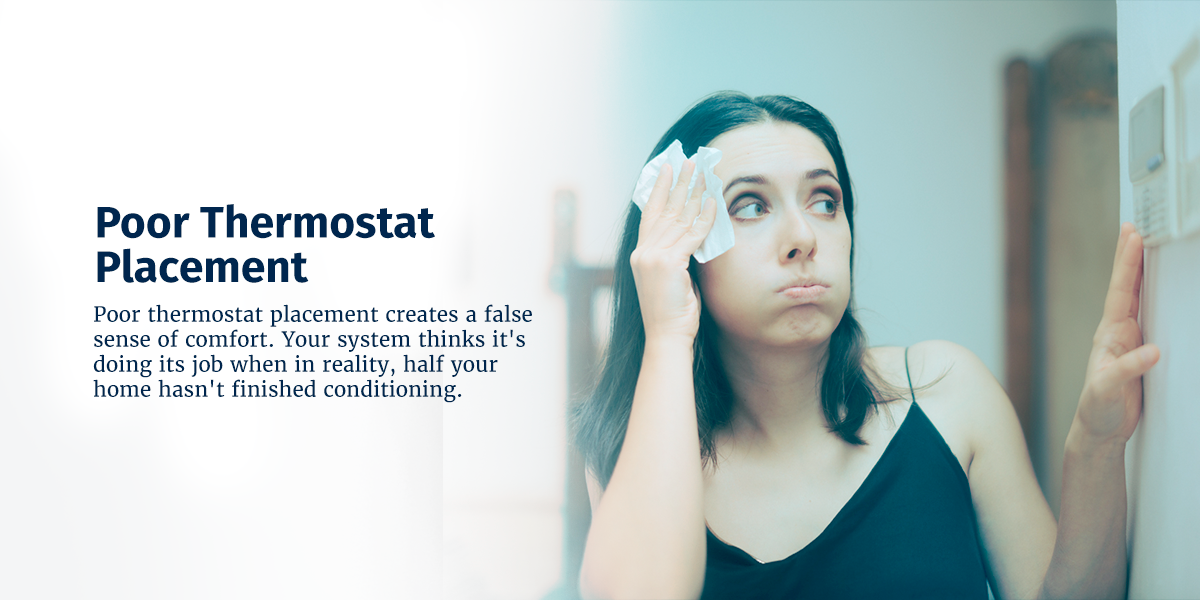
Poor Thermostat Placement
Your thermostat only measures the temperature in one spot. If that happens to be near a sunny window, a heat-generating lamp, or the kitchen, it will read warmer than the rest of your home and shut your system off early. The room with the thermostat is comfortable, but the far end of your house will stay too hot or cold.
Poor thermostat placement creates a false sense of comfort. Your system thinks it’s doing its job when in reality, half your home hasn’t finished conditioning. A Wi-Fi thermostat upgrade can give you better insight into whole-home temperature patterns and help you control comfort more precisely.
Why Upstairs Rooms Are Always Hotter
If you’re wondering why your upstairs is always hot, physics provides the answer. Warm air naturally rises, and cool air sinks. In a multistory home, your upper floor confronts a double challenge — rising heat from below and intense radiant heat from a Georgia attic pushing down through the ceiling.
A single-zone HVAC system with one thermostat on the ground floor has no way to compensate for this temperature difference.
The upstairs will almost always run warmer than the downstairs, especially during summer. Solving this problem usually requires a professional solution designed to address multistory temperature control.
Professional Solutions for Uneven Room Temperatures
If DIY steps don’t resolve your comfort issue, an experienced HVAC tech can identify potential airflow, ductwork, or system design flaws.
- Air balancing and airflow diagnostics: A trained technician can measure airflow at your supply and return vents using specialized tools. These measurements will show which rooms may receive too much or too little conditioned air.
- Damper adjustments: If your ductwork has internal dampers, adjusting them can improve air distribution throughout the home. This approach is more precise than adjusting vent louvers alone.
- Duct repair and sealing: Duct repair and sealing can reduce conditioned air loss before it reaches the problem room, improving comfort and letting your HVAC system operate more efficiently.
- Zoning systems: A zoned HVAC setup can be ideal for multistory homes, additions, or layouts with persistent hot and cold spots. Zoning divides the home into separate temperature areas, typically using individual thermostats and motorized dampers to direct airflow.
- Ductless mini-split systems: A ductless mini-split may be an option for a layout where one room consistently runs warmer or cooler than the rest. This solution can target a specific space without requiring major ductwork changes.
Contact Meeks Heating & Air for Whole-Home Comfort
Uneven temperatures are frustrating, but the good news is that they’re also fixable. At Meeks Heating & Air in Locust Grove, we’ll pinpoint the cause of your comfort problem and explain it in plain language, without padding the bill with unnecessary repairs. We’re a family-owned, A+ BBB-rated company and a Trane Comfort Specialist, but we service all brands.
Our team promises to serve your home as if it were our own. Join the Meeks Comfort Club for up to 15% off services, priority scheduling, and peace of mind with seasonal maintenance. Ready to get comfortable in every room? Call 470-622-8901 to schedule an appointment today.